Essay 01 · Varanasi to the Cloud
Getting to Varanasi
For two years, the trip lived only on my screen. Every few weeks I'd open the train booking site, type in the dates, and watch the same red word come up. Waitlist. I'd close the tab and tell myself I'd try again next month.
I tried again next month. And the month after. And the month after that.
By the end of March 2022, I was tired of being the person who kept almost going. One afternoon I gave up on trains entirely and opened a different tab. Buses. Multi-leg routes. Roundabout connections through cities I had never even passed through on a map. Within twenty minutes I had a plan that no sensible person would call a plan: Hyderabad to Nagpur by bus that evening, then a bus from Nagpur into Madhya Pradesh, then another bus up to Prayagraj in Uttar Pradesh, then a train into Varanasi.
I booked the first leg from my desk and was on it by night.
The buses ran for days. Somewhere past Nagpur the seats turned hard. Somewhere in Madhya Pradesh the air went hot and dusty. By the time the Prayagraj train pulled out of the platform I had stopped checking the time. The window was a long blur of fields and small stations whose names I forgot the moment I read them.
When I finally stepped onto the platform at Varanasi I looked like a man who had been walking for a week. Clothes wrinkled to nothing. Face I wouldn't have recognised in a mirror. The streets didn't care. In Varanasi nobody looks twice at a tired traveller — the place is full of them. Pilgrims, sadhus, students with no luggage, old men carrying nothing. Everyone in that city is on their way to or from the river.
I went straight to the river.
The Ganga was the colour of slow tea. I left my bag on the steps and waded in. The dirt of three buses and a train came off me and joined the dirt of millions of people who had stood where I was standing, going as far back as anyone could measure. I did darshan. I dried off. Then I went looking for somewhere to sleep.
A dormitory took me in. A bed, a fan, a wall painted the colour of an old envelope. I sat on the bed and decided two things. I would stay ten days. And I would start the next morning.
The bike rider
The bike rider who had brought me from the railway station was a Varanasi man who knew the city's lanes the way a librarian knows shelves. I had kept his number. I called him in the morning and told him I wanted to see temples.
He nodded into the phone in the way people nod when they have already done the thing being asked of them. He had heard this request a hundred times.
For three days he rode and I sat behind him. The city came at me through the gaps in his shoulders. Old walls. Narrow lanes. A cow asleep in the middle of the road. A bell ringing somewhere I could not see. He would park at a temple, point with his chin, and wait. I would go in.
Durga Kund. Tulsi Manas Mandir, where the Ramcharitmanas is written in white marble around the inner walls. The new Kashi Vishwanath inside the Banaras Hindu University campus, set among long lawns that don't feel like the rest of the city. Gavalamma — a small shrine to a sister of Shiva, easily missed if you don't know to ask. Varahi, where you go before dawn or not at all. Batuk Bhairav. Kal Bhairav.
He took me out of the city too. Sarnath, an afternoon's quiet ride away, where the Buddha gave his first sermon — a place that has been peaceful for two thousand five hundred years and feels it. Ramnagar Fort across the river, a heavy old building of yellow sandstone watching the water go by.
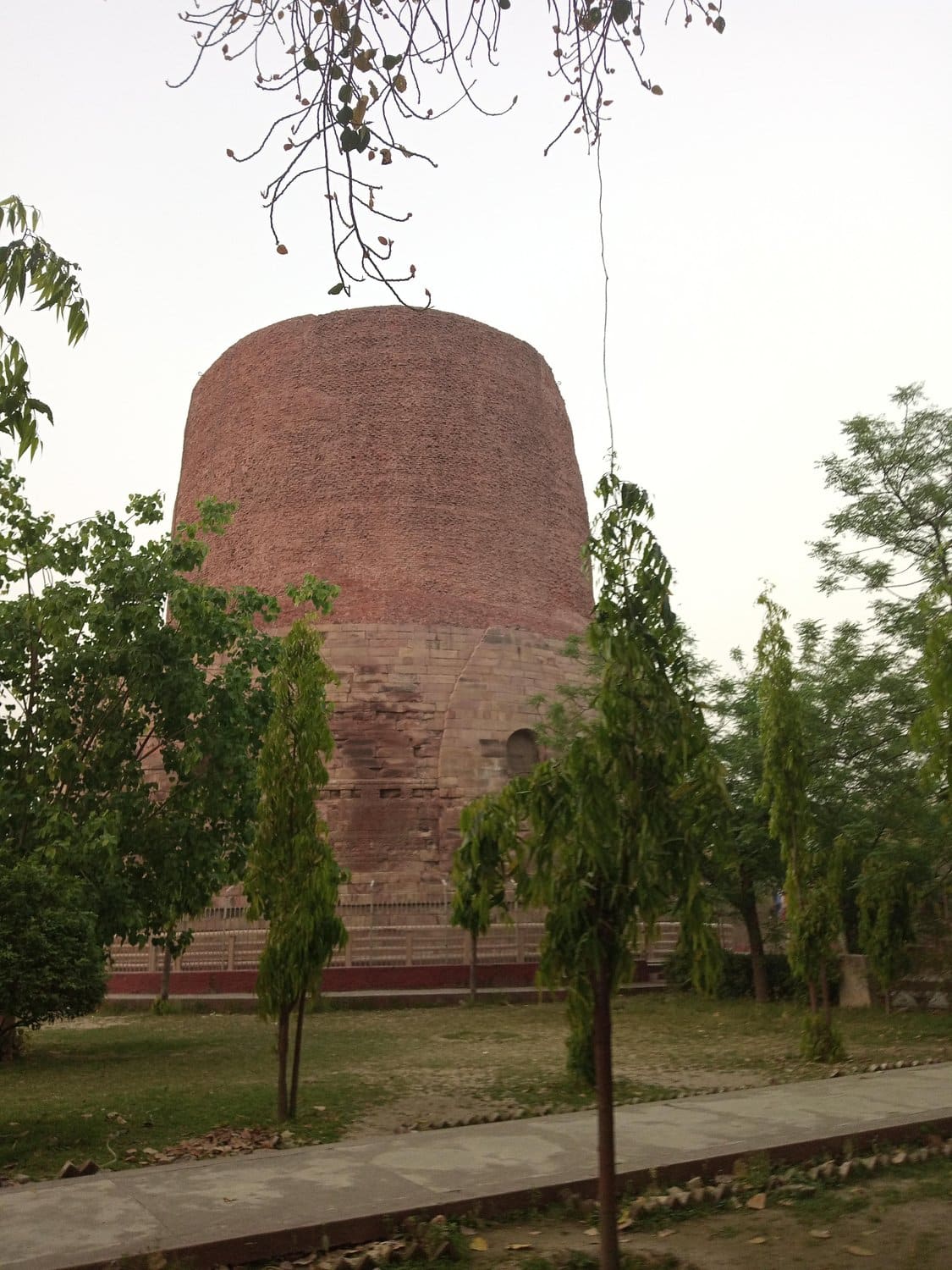
On the fourth morning he didn't come. He had done his job. After that I walked.
What you feel inside the temples
I will not try to describe what happens inside those temples, because the words make it smaller. I'll only say this. At every one of them there is a vibration that does not start in the room — it starts in the chest. Each temple's hum is different. Each one is somehow familiar. As though, before you ever set foot in them, you have already been tuned to receive them.
After a few days a strange thing happens. You stop calling it travel. You start calling it coming home. Not to the home where you were born. To a deeper one. One that has been waiting.
Manikarnika
Three places out of all of them sit in my memory more sharply than the others.
Dashashwamedh Ghat in the evening, when the priests stand in a row and lift their oil lamps over their heads and the river goes black with reflected fire and the crowd makes one sound out of a thousand voices.
Sarnath in the afternoon, where you can stand in front of the stupa and feel time slow down by half.
And Manikarnika.
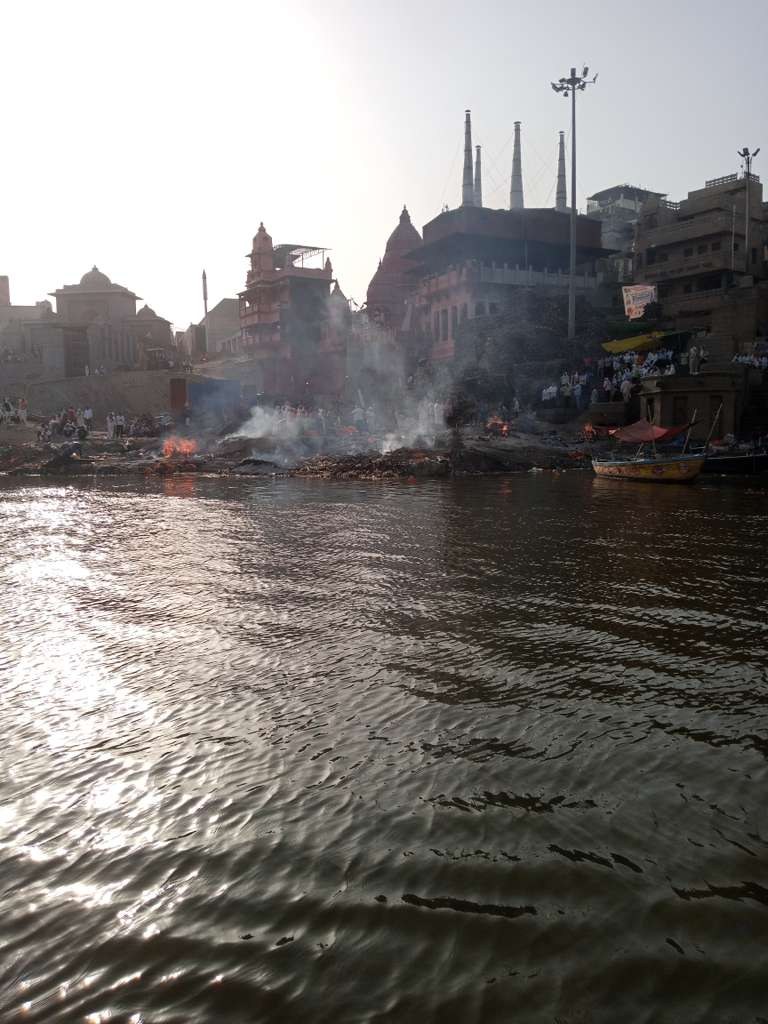
Manikarnika is the burning ghat. The bodies arrive on bamboo, wrapped in white cloth, carried at shoulder height by men chanting Ram naam satya hai — the name of Ram is the truth. They lay them down by the river. The pyres burn day and night. They have burned day and night for as long as anyone in this country can remember.
I went there in the daytime first, after my temple visits — watched for an hour, came back, freshened up. Then that night I went back and sat down on the steps. I sat there a long time. I did the same the next night, and the night after.
One of those nights there was an Aghora at the ghat — or a man people were calling Aghora; I never asked his name. He was performing a rite near a body that had not yet been burnt. Tending a small fire, cleaning the ground around it, pouring something, muttering. He stayed in that one spot for hours. A handful of people stood near him at a polite distance, keeping the curious back, refusing cameras. I sat further away and watched.
I never spoke to him. He never looked at me. I was inside the space and not part of it.
If you sit at Manikarnika long enough, something quiet happens to you. You watch a body come down with its family around it. The family stays as long as the fire is hot. Then the family leaves. The fire keeps going on its own for a while. Then the wood is gone. And then someone else's body is on the same spot.
Whatever the person did — the degrees, the job, the house, the savings, the love, the fights — none of it gets on the bamboo. Even the family that carried them there walks away when their part is done. In two generations the people who remembered them are also on the bamboo. Then those who remembered them. And so on, back into the river of dark behind us.
You can read this idea in a book and it sounds like a problem to solve. You can sit with it at Manikarnika and it sounds like the weather. It is just what is.
Leaving
I did not leave Varanasi because of a revelation. I had given myself ten days and the ten days ended. I filled a small bottle with Ganga water, packed my bag, and worked my way back south the same long way I had come.
But you do not leave Varanasi the way you leave other cities. The vibration in the chest follows you. It is harder to feel under fluorescent office light than at a ghat in the dark, but it is not gone. When something gets heavy — a project goes sideways, a year goes by faster than you wanted, an outcome you'd rehearsed slips away — a picture comes up. A family walking away from a fire. An Aghora tending his spot at three in the morning. The way none of it, in the end, gets on the bamboo.
The grip loosens. Not all the way. Just enough.